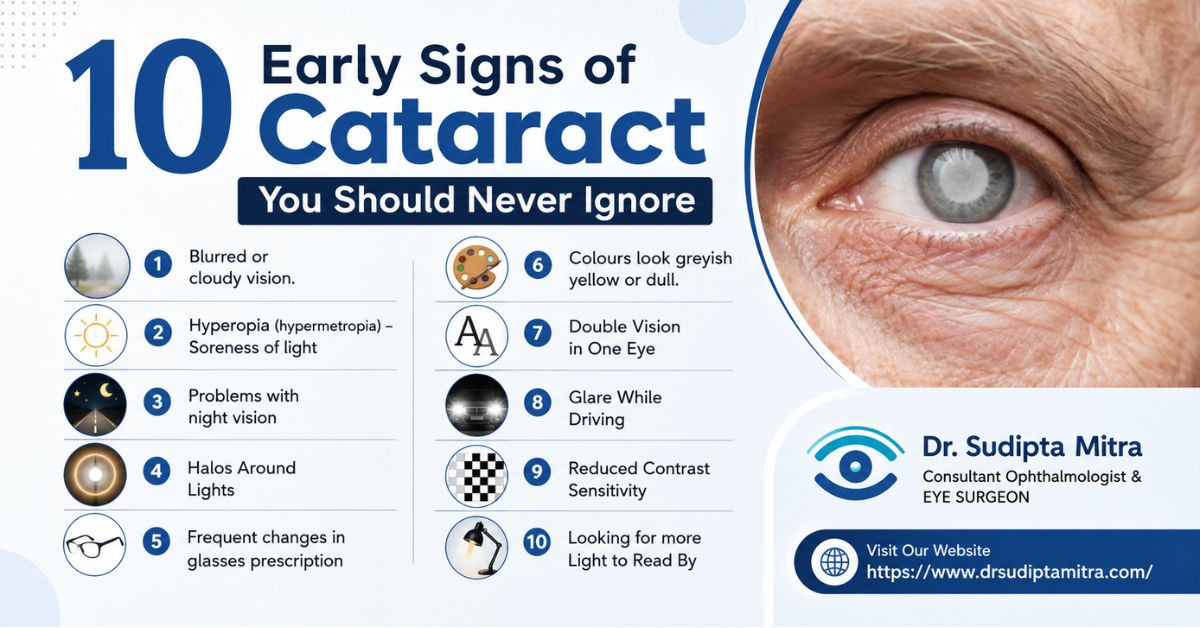
Although our eyes are something we use daily, many people don’t realise how important they are until there are changes that they start to notice. The most frequently occurring disease of the eye causing impaired vision, particularly as a person gets older, is cataract. Cataracts slowly develop and, due to the gradual nature of the changes, many people do not notice the early signs and symptoms.
Fortunately, prompt detection and treatment can save vision and a good quality of life. Dr Sudipta Mitra explains in this blog about the early signs of cataract that should not be neglected.
What Is a Cataract?
A cataract is a clouding of the natural lens in the eye. The lens is supposed to be transparent and to refract light onto the retina, so that we can see. As cataracts grow, they scatter or block the light, and this makes it harder to see clearly.
While often linked to age, cataracts can also occur as a result of diabetes, eye injuries, long-term steroid use, too much UV exposure, smoking or medical conditions.
Early recognition of symptoms will make it easier and more effective to treat.
10 Early Signs of Cataract
1. Blurred or cloudy vision.
Blurring vision is one of the early, common symptoms of cataract. Others say that it is like looking through a foggy window or a misty glass.
Reading may be harder, the faces may look blurry, or road signs may be harder to read than usual. Because the change is gradual, people might believe that it’s just due to the ageing process or tired eyes.
If your glasses have lost their ability to give you clear vision, you may need an eye exam.
2. Hyperopia (hypermetropia) – Soreness of light
Is it suddenly strange for you to be around bright lights? Your eyes may be more sensitive to light, such as sunlight, headlights or indoor lights.
It may be uncomfortable to walk around during the day or drive at night. Light can be brighter than is needed, and can interfere with activities.
Patients should not dismiss persistent light sensitivity, particularly if they have no known cause, Dr Sudipta Mitra frequently reminds them.
3. Problems with night vision
Other early signs of cataracts include night vision. The majority of individuals report that driving at night is more difficult.
Street lights, headlights and traffic signals may appear dimmer or less distinct. Black or dark rooms can also look even darker than they did before.
Loss of night vision may impact safety; early consultation is important.
4. Halos Around Lights
Ever seen “ring of light” or “glowing circles” around lights at night?
The phenomenon is known as halos, and is usually linked to cataracts. The clouded lens causes light sources to have bright rings around them when viewed through the lens.
Haloes form around:
- Vehicle headlights
- Street lamps
- LED lights
- Indoor bulbs
If halos begin to affect the person’s daily functioning, his or her eyes should not be ignored.
5. Frequent changes in glasses prescription
When you just continuously swap out your glasses and still cannot see clearly, there’s a chance that you are suffering from cataracts.
Numerous patients come to eye clinics and experience better vision only when they change their glasses. The lens continues to change over time with the progression of the cataract, impacting the quality of vision.
Multiple changes to a prescription in a brief time frame should always be reviewed.
6. Colours look greyish yellow or dull.
In addition to impacting clarity, cataracts can also cause changes in colour perception.
You’ll start to see that:
White objects look yellowish
Bright colours appear dull.
Contrast becomes poor
The colours of everyday things fade away.
This change is not always noticed, as it takes months or years to happen.
Many patients are amazed at how vivid and brightly coloured objects appear to them after the cataract surgery.
7. Double Vision in One Eye
Another early symptom is double vision (monocular double vision) through one eye.
This is not double vision associated with nerve or muscle disorders. A cloudy lens can cause cataracts to refract the incoming light, resulting in overlapping images.
You might notice:
- Letters appearing duplicated
- Objects looking shadowed
- A lack of concentration on details
The sudden onset of this symptom is suggested for immediate assessment.
8. Glare While Driving
Many people complain of headlights from oncoming vehicles causing a lot of glare while in the cataract stage.
This glare can be distracting or even hazardous, especially at night. Wet roads and reflective surfaces can aggravate the situation.
Glare-induced driving discomfort is never a trivial matter, as it may be a sign of lens clouding.
9. Reduced Contrast Sensitivity
Contrast sensitivity is the ability to differentiate objects from the background.
When people have cataracts, they might have trouble recognising:
- Steps and stair edges
- Text against similar colours
- Glossy, facial details in low light.
- Objects in low contrast environments
This problem could contribute to a fall risk, particularly for older adults. It is often confused with a general vision weakness, but it may be an early symptom of cataract.
10. Looking for more Light to Read By
When you suddenly require more light to read newspapers, books or your mobile phone screen, it could be a sign of developing cataract.
You may find yourself:
- Moving towards the lamps
- This will help reduce the brightness of the screen. Repeat the increase of brightness several times.
- Disliking the light that is in the house
- Having trouble reading the fine print in small print
Changes with ageing may play a role, but if it doesn’t go away, it should be seen by a professional.
When to Visit an Eye Doctor?
Though not all blurry vision problems are caused by cataract, they may further deteriorate if not treated. If you have any of these symptoms, you should seek an eye exam, Dr Sudipta Mitra advises.
- Persistent blurred vision
- Night driving difficulty
- Frequent spectacle changes
- Glare or halos
- Colour distortion
- A growing reliance on light.The tendency to rely more on bright light.
Early diagnosis enables the determination of the grade of the cataract and enables appropriate planning for the treatment at the appropriate time.
Schedule Your Appointment Today:
- Phone: 9830260283
- Online Booking: click here
Final Thoughts
Cataract typically progresses over time, and this is why many people don’t realise that they have it in the early stages. But early signs of vision problems, like blurred vision, glare, halos, colour distortion and trouble seeing at night should never be ignored.
The sooner cataracts are diagnosed, the sooner they can be controlled and vision restored.